Explore examples
| Identifier | Name | Description |
|---|---|---|
| S000001 | The Rieger–Nishimura ladder | Rieger and Nishimura introduced this construction to study free Heyting algebras on one generator. In particular, the ladder displayed here is the Esakia dual to this algebra. |
| S000002 | Fine general frame | K. Fine introduced this frame to study incompleteness of S4 logics. V. Shehtman later adapted it to obtain an incomplete superintuitionistic logic. It has served as a useful source of counterexamples: for instance, G. Bezhanishvili, D. Gabelaia, and M. Jibladze employed it in their negative solution to Kuznetsov’s problem for bi-Heyting algebras. |
| S000003 | Mardaev frames | The dual algebras were introduced to study pre-locally tabular superintuitionistic logics and to prove that there are continuum many of them. |
| S000004 | WB graph frame | This frame was introduced in our studies of pre-local tabularity and local tabularity, seeking a width-bounded locally tabular logic: it is not locally tabular, but all finitely generated algebras of bounded width in its variety are finite. Every finitely generated algebra in this variety is co-Hopfian. |
| S000005 | Young lattice Fine frame | Young's lattice of partitions was introduced by A. Young in the study of integer partitions in combinatorics and number theory. This particular construction models the Fine general frame, and replaces its "kernel" (the bottom ascending part) by Young's lattice of partitions, obtaining interesting properties. |
| S000006 | Double omega frame | Coming soon |
| S000007 | Hyttinen–Martins–Moraschini–Quadrellaro | Coming soon |
| S000008 | Bellissima’s construction | Bellissima’s universal model gives a representation of the free Heyting algebra on two generators by building the "image-finite part" of the dual space. The construction is recursive, and proceeds by layers, taking into account the structure of successors and the "colors" -- the propositional variables satisfied by each point. |
| S000009 | Modified Rieger-Nishimura ladder | A modified Rieger-Nishimura ladder with an added point on top. |
| S000010 | Countable fork | An order on the space omega+1, placing the compactification point on the bottom. Simple example of Priestley space which is not Esakia. |
| S000011 | Countable co-fork | An order on the space omega+1, placing the compactification point on the top. An Esakia space which is not bi-Esakia. |
| S000012 | Deleted top 2-chain space | The space with the upper set of isolated points deleted. Another example of a Priestley space that is not Esakia. |
| S000013 | Deleted bottom 2-chain space | The space with the lower set of isolated points deleted. An Esakia space that is not bi-Esakia. |
No matching entries.
The Rieger–Nishimura ladder
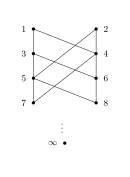
Rieger and Nishimura introduced this construction to study free Heyting algebras on one generator. In particular, the ladder displayed here is the Esakia dual to this algebra.
Fine general frame
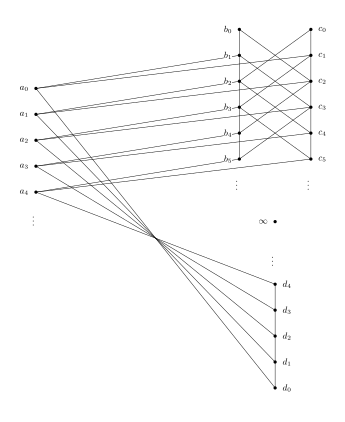
K. Fine introduced this frame to study incompleteness of S4 logics. V. Shehtman later adapted it to obtain an incomplete superintuitionistic logic. It has served as a useful source of counterexamples: for instance, G. Bezhanishvili, D. Gabelaia, and M. Jibladze employed it in their negative solution to Kuznetsov’s problem for bi-Heyting algebras.
Mardaev frames
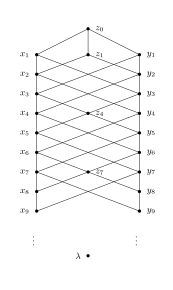
The dual algebras were introduced to study pre-locally tabular superintuitionistic logics and to prove that there are continuum many of them.
WB graph frame
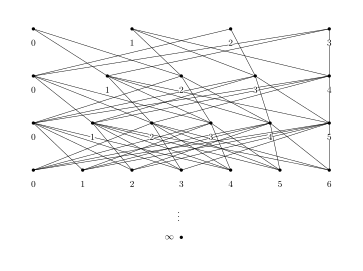
This frame was introduced in our studies of pre-local tabularity and local tabularity, seeking a width-bounded locally tabular logic: it is not locally tabular, but all finitely generated algebras of bounded width in its variety are finite. Every finitely generated algebra in this variety is co-Hopfian.
Young lattice Fine frame
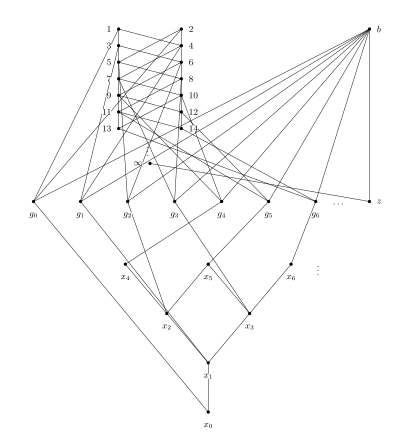
This frame arose in our studies of completeness theory, seeking the extent of the Artin-gluing based completion method which was found to work for the Fine general frame.
Double omega frame
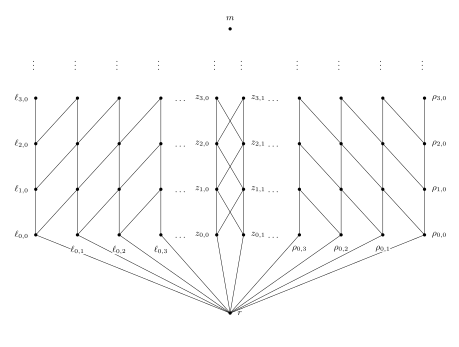
Coming soon
Hyttinen–Martins–Moraschini–Quadrellaro
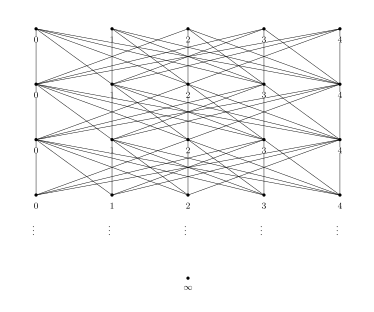
Coming soon
Bellissima’s construction
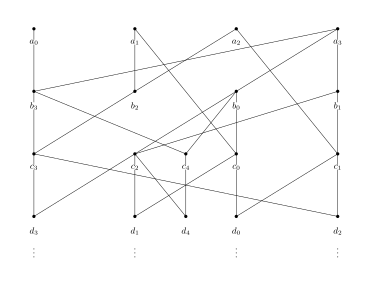
Bellissima’s universal model gives a representation of the free Heyting algebra on two generators by building the "image-finite part" of the dual space. The construction is recursive, and proceeds by layers, taking into account the structure of successors and the "colors" -- the propositional variables satisfied by each point.
Bellissima’s universal model is the image-finite part part of . We begin with four maximal points, one of each colour , , , .
At each round we build a new layer of as follows: pick a finite antichain from the existing model, containing at least one point from the preceding layer, and a color which is below the color of each point in this antichain; then add a point which has as its successors, and is colored .
The interactive display shows the four maximal points, and a selection of 18 points (the layers grow extremely quickly -- at the third layer several hundreds or thousands of points). The color upsets in the end are given by the points sharing the colors and .
At the end of the construction, the poset will contain a copy of each (irreducible) 2-generated Kripke model.
Modified Rieger-Nishimura ladder
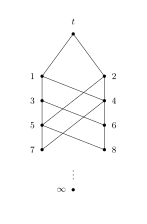
This simple modification of the RN-ladder can be obtained as a p-morphic image of it, and appears recurringly in studies of completeness: in degrees of FMP, pre-local tabularity, amongst other places.
Countable fork
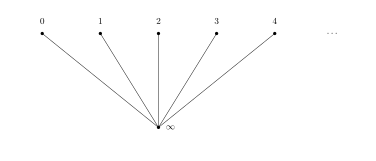
Infinite fork space.
Countable co-fork
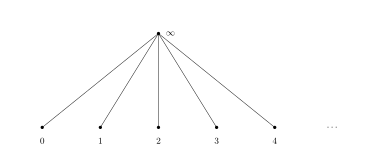
Infinite co-fork space.
Deleted top 2-chain space
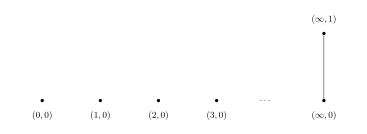
The space with the upper set of isolated points deleted. Another example of a Priestley space that is not Esakia.
Deleted bottom 2-chain space
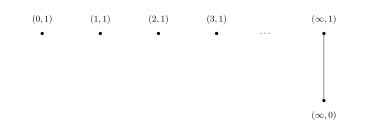
The space with the lower set of isolated points deleted. An Esakia space that is not bi-Esakia.